
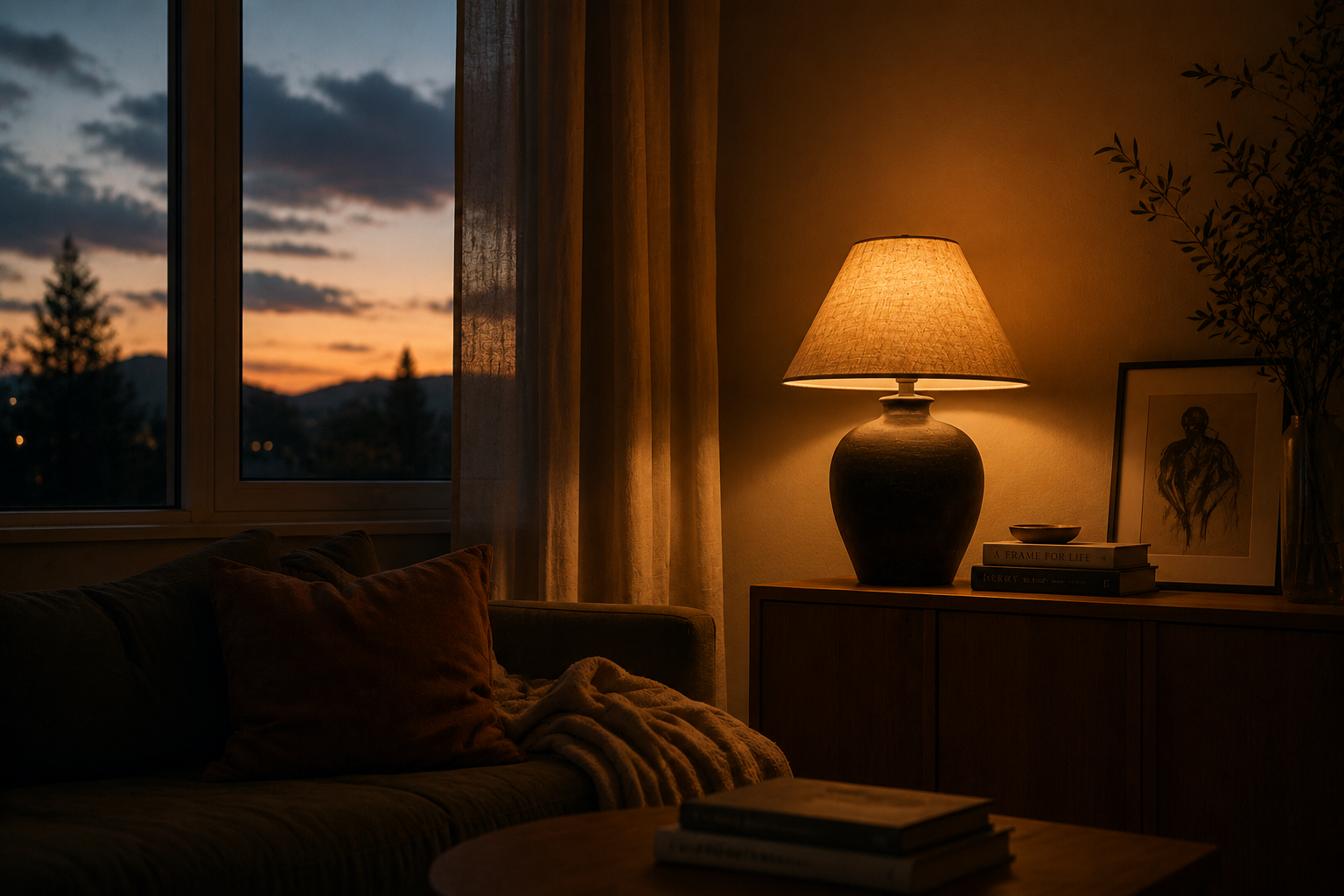
There is a moveable feast of a moment in the late afternoon/early evening when a home should transition from daylight to lamp light.
Go too early and the house feels theatrically gloomy; too late and everybody has been sitting under what the British correctly refer to as “the big light” like participants in an administrative hearing.
The correct moment is difficult to define precisely, but is instantly recognisable when achieved – and equally noticeable when missed.
It is less about illumination and more about atmosphere.
A lamp switched on at the proper time communicates:
- the day is softening,
- nobody needs to rush,
- and civilisation, despite recent evidence to the contrary, will likely continue for at least another evening.
I increasingly suspect that many domestic rituals exist primarily to create emotional transitions between different parts of the day.
Lighting lamps.
Making tea.
Putting music on while cooking.
Closing curtains against bad weather.
None are strictly necessary.
And yet I have been learning recently, through Oliver, how much easier transitions can become when they are clearly signalled.
A change in lighting.
A familiar piece of music.
The quiet choreography of evening routines.
For him, these signals help soften movement between one state and another; between activity and rest, stimulation and calm.
But perhaps this is not uniquely neurodivergent at all.
Perhaps most human beings are quietly dependent on atmospheric cues guiding us gently between different versions of ourselves throughout the day.
Without these cues, life begins to feel strangely procedural.
Like remaining indefinitely inside office lighting.
Perhaps this is why aggressively functional homes often feel faintly unsettling.
A home should not merely support biological survival.
It should occasionally imply:
stay awhile.
Anyway.
The lamps are on.