
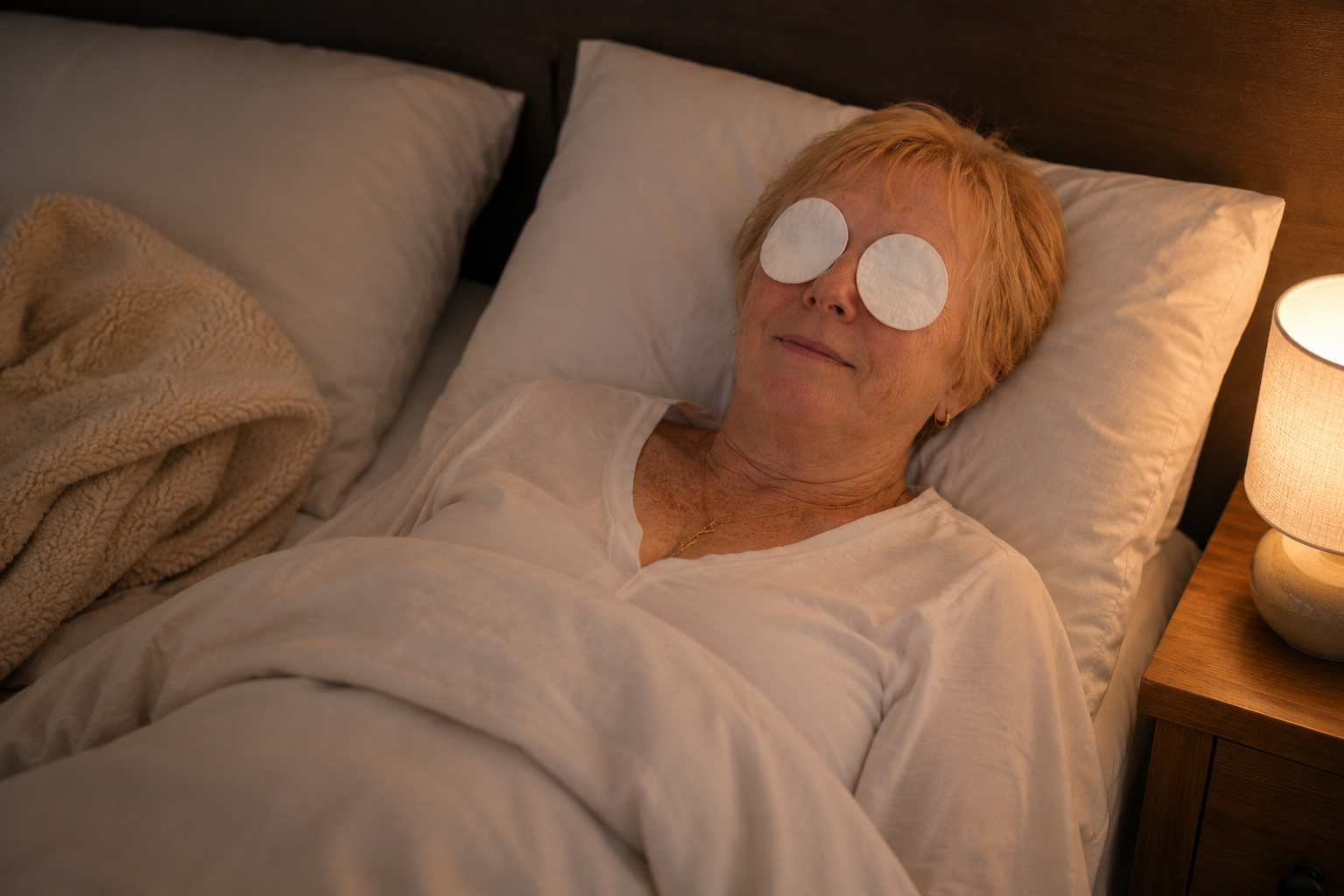
Joy has some sort of minor skin irritation at the moment.
This has resulted in our bathroom slowly transforming into a small pharmaceutical outpost populated by:
- lotions,
- ointments,
- eye drops,
- and increasingly specific discussions about inflammation.
One of the complications is that the lotion appears to migrate into her eyes overnight because she rubs them in her sleep.
Which feels unfair, honestly.
You attempt to solve one problem and accidentally create another entirely different problem several centimetres away.
Anyway, while helping with eye drops yesterday, I suggested placing makeup remover pads over her eyes while applying the lotion so it stayed slightly further away from the eye socket.
This appears to have worked surprisingly well.
A tiny domestic adjustment.
A soft barrier placed in exactly the right spot.
Meaningfully better sleep.
A lot of successful adulthood works exactly like this.
Not through discipline. Not through optimisation. Not through becoming fundamentally better humans.
Mostly through quietly reducing friction.
Hooks near the door where bags naturally accumulate. Chargers where people actually sit. Dim lights for nighttime bathroom trips.
Not surprisingly, good systems outside our apartment seem to operate from pretty much the same premise.
Roundabouts acknowledge that humans are bad at four-way negotiations while travelling at speed.
Kerb cuts originally designed for wheelchairs now help:
- prams,
- suitcases,
- trolleys,
- bicycles,
- and tired people dragging groceries home.
Automatic doors quietly accept that humans often have their hands full.
USB-C finally acknowledged that perhaps the cable should fit whichever way exhausted humans attempt to plug it in.
Speed bumps do not request moral improvement from drivers.
They simply accommodate the statistically inevitable reality that somebody will attempt the corner too quickly.
The best systems rarely demand ideal behaviour.
They accommodate ordinary behaviour instead.
Which is a profoundly different philosophy.
Bad systems tend to assume:
- perfect memory,
- perfect timing,
- perfect compliance,
- perfect emotional regulation,
- and perfectly attentive humans.
Good systems quietly acknowledge reality instead.
People forget things.
People get tired.
People carry too much.
People rub their eyes while asleep.
Civilisation, at its best, is often just the gradual reduction of unnecessary friction.
A makeup pad here. A roundabout there.
A slightly kinder expectation of what humans are actually like.
None of this is especially dramatic.
But then again, most meaningful care isn’t. As I have suggested before it sometimes arrives disguised as logistics.
Anyway.
It’s not contagious.