
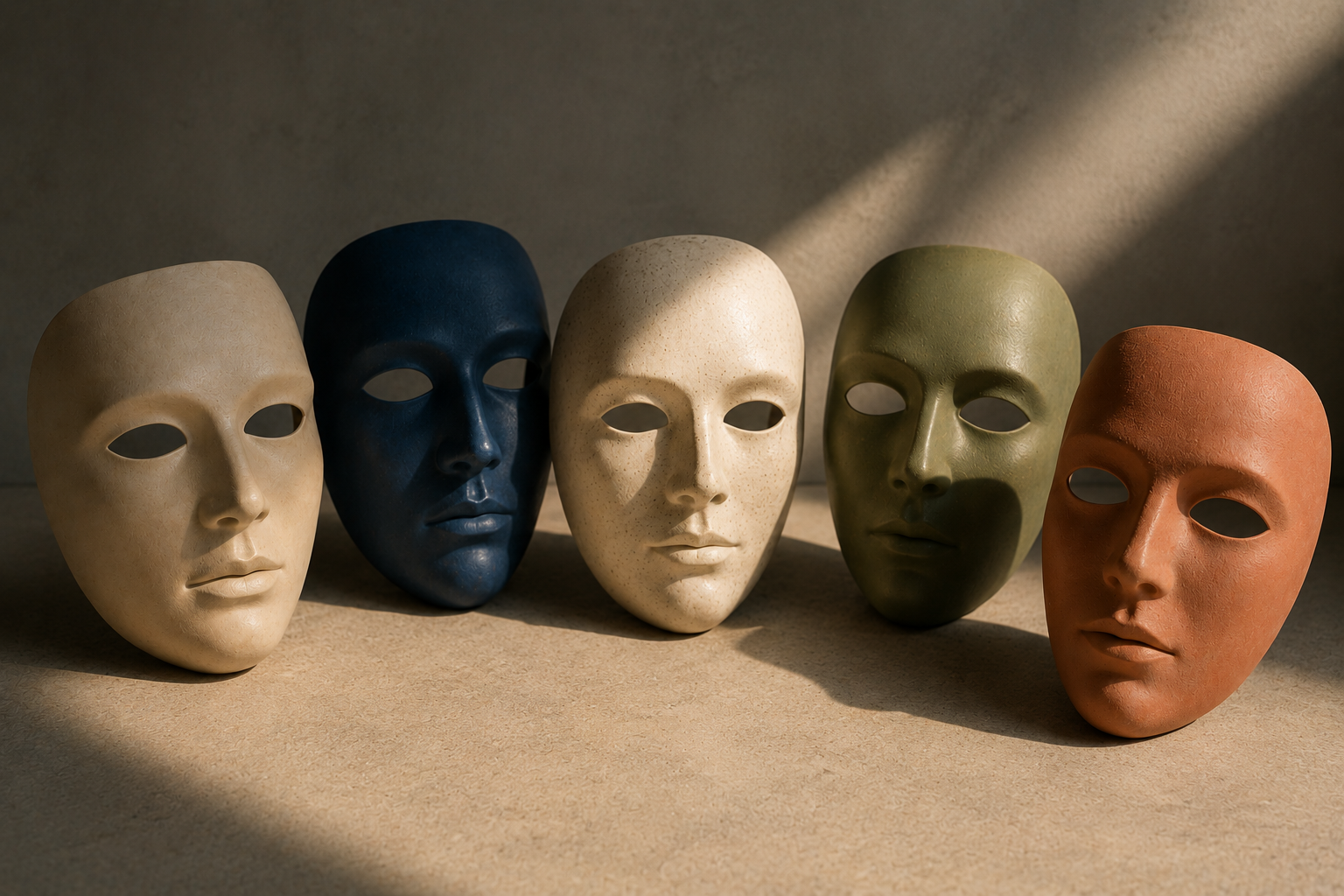
There is a particular kind of modern anxiety that insists authenticity must be singular.
That the “real you” should sound the same:
- in conversation,
- in writing,
- online,
- in person,
- at dinner,
- in conflict,
- in grief,
- and while replying “per my previous email.”
Increasingly, people seem suspicious of any noticeable variation between these versions of self. If somebody is warm online but reserved in person, reflective in writing but sharp in conversation, articulate publicly but awkward privately, we instinctively begin hunting for which register is “real.”
As though personality inconsistency necessarily implies deception.
I am increasingly unconvinced by this.
A friend recently described an article on this site as:
“really lovely… but where is Gareth?”
And I knew exactly what he meant.
The site voice is gentler than my conversational voice. More patient. More reflective. Less immediately corrective. The in-person version of me, particularly around people I love and who know me well, tends toward fast analysis, directness and the occasional unfiltered soothsaying. The site version is more interested in arrangement. Observation. Letting things sit in the room for a moment before puncturing them.
But neither voice feels false to me.
Writing changes the thought process and the expression of the result.
Conversation rewards:
- speed,
- instinct,
- interruption,
- energy,
- social calibration
- collaboration.
Writing rewards:
- selection,
- rhythm,
- reflection,
- and arrangement.
The differences between the two are not evidence of dishonesty any more than the difference between speaking and singing is evidence of fraud.
And yet modern internet culture increasingly behaves as though every version of the self should be a curated collapse into one permanently accessible personality construct. Public self. Private self. Written self. Spoken self. Professional self. Intimate self. All expected to align perfectly at all times under constant observational pressure.
I suspect this is psychologically disastrous.
Historically, humans benefited enormously from impermanence. The angry pub conversation disappeared into the air. The ill-judged joke remained inside the room that heard it. The frustrated version of the self did not become permanently discoverable by employers, strangers and future adversaries.
Modern life increasingly removes that mercy.
A single captured moment now routinely attempts to overwrite the existence of every other register of the self. The private self becomes evidence against the professional self. The exhausted self invalidates the thoughtful self. The cruel joke, the drunken remark, the furious text message — each arrives stripped of context and presented as the definitive version of a person.
Which perhaps explains why people increasingly perform continuity so aggressively now.
But, humans are contextual creatures. Compression is performance. A personality that never varies does not strike me as authentic. It strikes me as managed.
We have always occupied different voices in different contexts. A person at dinner does not sound like the same person writing correspondence. Someone arguing in a pub does not sound like themselves in grief. Essayists rarely sound conversational in essays because essays are not conversation. They are thought slowed down enough to become architecture.
Which is perhaps why good writing can feel strangely intimate even when it is obviously curated.
Not because it is unfiltered.
But because it is carefully filtered toward something specific and true.
I also think people routinely underestimate how much warmth can exist beneath restraint. Modern communication increasingly performs sincerity through over-disclosure, emotional explicitness and relentless self-explanation. But some personalities express affection through:
- precision,
- specificity,
- observation,
- ritual,
- and noticing.
The warmth exists. It is simply encoded differently.
Perhaps in the noticing of how someone takes their coffee. In the specific book left on the right pillow. In the correction offered because you believed they deserved the truth.
Perhaps authenticity is not singular at all.
Perhaps the error lies in assuming a person should compress cleanly into one stable voice regardless of medium, context or emotional temperature.
Some selves are conversational.
Some are reflective.
Some are ceremonial.
Some only emerge slowly in writing.
All of them may still be real.
Anyway.
You do you.