
There is a particular kind of British sentence which manages to reveal an entire civilisation accidentally.
In Rivals, a young man is discovered by his father in the woods on the morning of a shoot receiving “manual stimulation” from an estate worker.
The matter is quietly referred to his mother, who barely looks up from her newspaper while delivering administrative correction.
“Boarding school is undoubtedly a lonely place where certain extracurricular activities are tolerated,” she tells him. “One should exercise restraint when closer to home.”
And honestly, if you were raised anywhere near British institutional culture, the sentence lands with the force of divine recognition.
Because it perfectly captures the strange historic arrangement surrounding male homosexuality in British life:
officially condemned,
unofficially tolerated,
provided it remained properly compartmentalised.
The thing itself was often less important than where it occurred.
Boarding schools.
The military.
The theatre.
Oxford and Cambridge.
Certain clubs.
Certain bachelor arrangements.
Certain friendships suspiciously intense across several decades.
All perfectly understandable.
Provided nobody collapsed the ambiguity too completely.
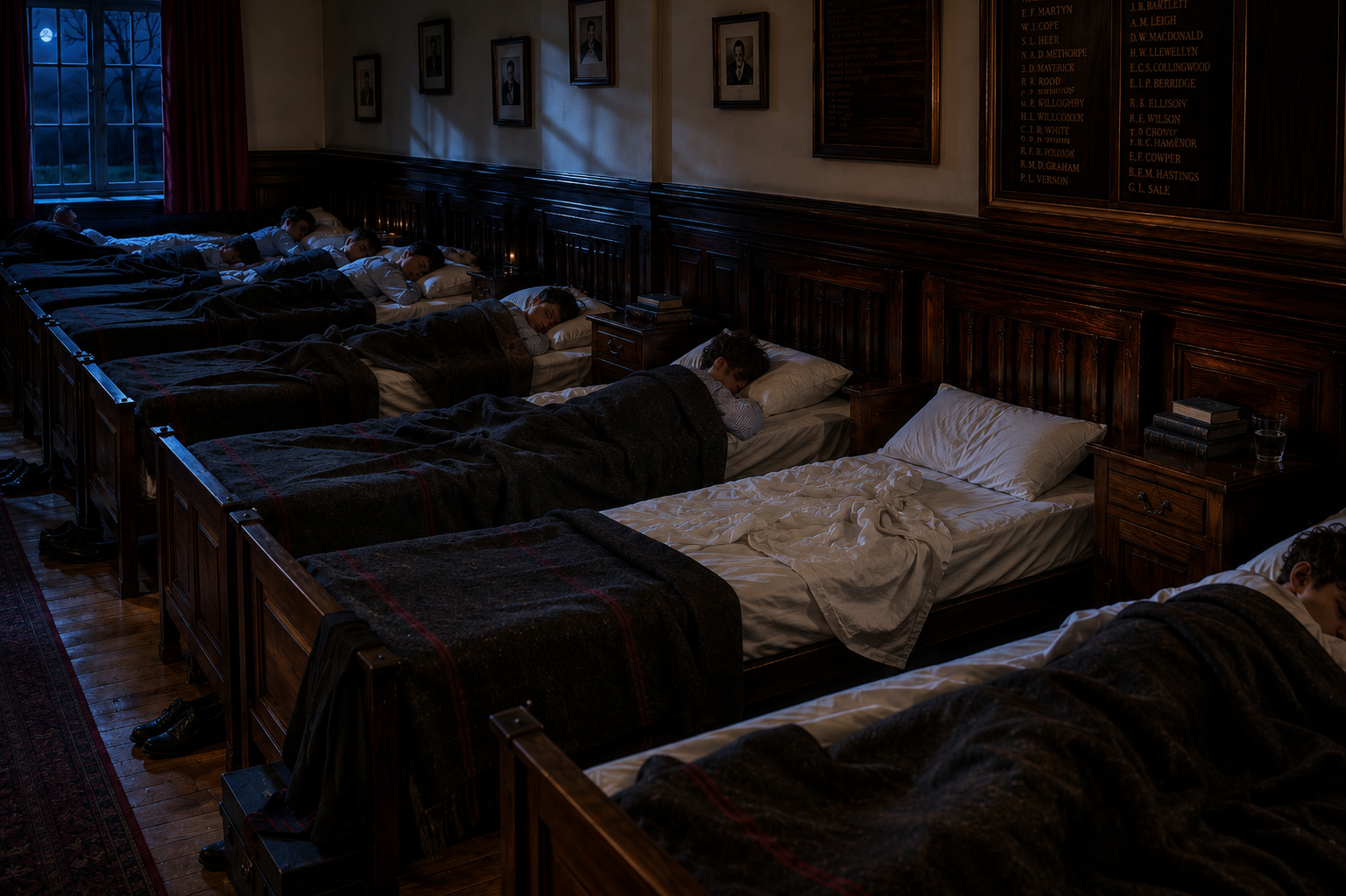
I attended an all-boys boarding school.
And in retrospect, the sheer quantity of “experimentation” occurring within an environment containing thirty adolescent boys per house now seems less shocking than statistically inevitable.
What strikes me, looking back, is not that it happened.
It is that nobody seemed to think it required identity.
There was no obvious “gay one.”
Or at least not in the modern sense.
There were boys considered theatrical.
Sensitive.
Arty.
Slightly too interested in the school production.
But the actual after-lights-out shenanigans existed in a curious institutional blind spot where behaviour and identity remained entirely disconnected.
The implicit understanding appeared to be:
boys will be boys,
school will be school,
and adulthood will eventually restore proper order.
Which sounds absurd now.
And yet it formed the emotional atmosphere of enormous sections of British and Commonwealth institutional life for generations.
This was not, at least in my experience, an environment of overt oppression.
I was not persecuted.
Nor ostracised.
I was popular with both peers and staff.
House captain, for God’s sake.
Which perhaps makes the whole thing more interesting.
Systems do not only shape people through punishment.
They shape people through acceptance.
Especially institutions built around hierarchy, performance, masculinity, emotional restraint, and the careful management of appearances.
You learned very quickly what could be spoken directly and what should remain atmospherically implied.
And British culture has historically developed an extraordinary number of mechanisms for saying things without technically saying them.
“Mary.”
“Friend of Dorothy.”
“Confirmed bachelor.”
“Camp.”
“Artistic.”
“Her.”
The pronoun itself perhaps being the most elegant achievement of all.
“Jesus, look at her.”
Entire generations of British men apparently able to discuss objectively magnificent males while maintaining the collective fiction that everybody remained aggressively heterosexual.
Because the system was rarely designed to eliminate desire entirely.
Only to redirect it safely into humour,
performance,
campness,
irony,
or plausible deniability.
At the very top of British institutional life sits the royal family’s unofficial mantra:
never complain,
never explain.
Which may also be the defining emotional philosophy of the entire civilisation.
Feel whatever you like.
Endure whatever you must.
But for God’s sake maintain the structure and do not force everybody else to acknowledge the thing directly.
And to be clear: there absolutely were limits.
Be too overt,
too explicit,
too visible,
collapse the ambiguity too completely,
and suddenly the consequences became extremely real.
Oscar Wilde remains the archetypal warning.
British society was perfectly capable of tolerating homosexuality provided it remained witty enough, coded enough, useful enough, and socially deniable.
The problem with Wilde was never merely that he desired men.
It was that he insisted on collapsing the ambiguity.
He stopped implying.
Stopped coding.
Stopped allowing society its preferred escape route.
And British institutions have historically reacted very badly to being forced to acknowledge what they already know.
Which perhaps explains why so much gay culture in Britain evolved around indirection.
Polari.
Campness.
Wit.
Double meanings.
Theatricality.
Emotion disguised as humour.
Confession disguised as irony.
A sort of national talent for saying emotionally true things sideways.
And looking back now, what fascinates me most is not the institutional sociology of it all.
It is that among the general fog of adolescent experimentation, there remains one particular boy I can still picture with alarming clarity.
Not “boys at school.”
Him.
The anticipation.
The fixation.
The emotional charge.
The absurd significance attached to casual interactions.
The memory remains so vivid that one begins, somewhat belatedly, to suspect one may have been participating in the extracurricular programme with slightly more enthusiasm than some of one’s peers.
Anyway.
Vada the bona omi.