
There is a particular kind of absurdity unique to modern appliances.
Older machines were often loud, ugly, and deeply inefficient.
But they were honest.
If your dishwasher from 1987 made a terrible noise, it meant one of three things:
- something had broken,
- something was about to break,
- or a spoon had escaped into somewhere spoons should not be.
The relationship may have been adversarial, but it was at least understandable.
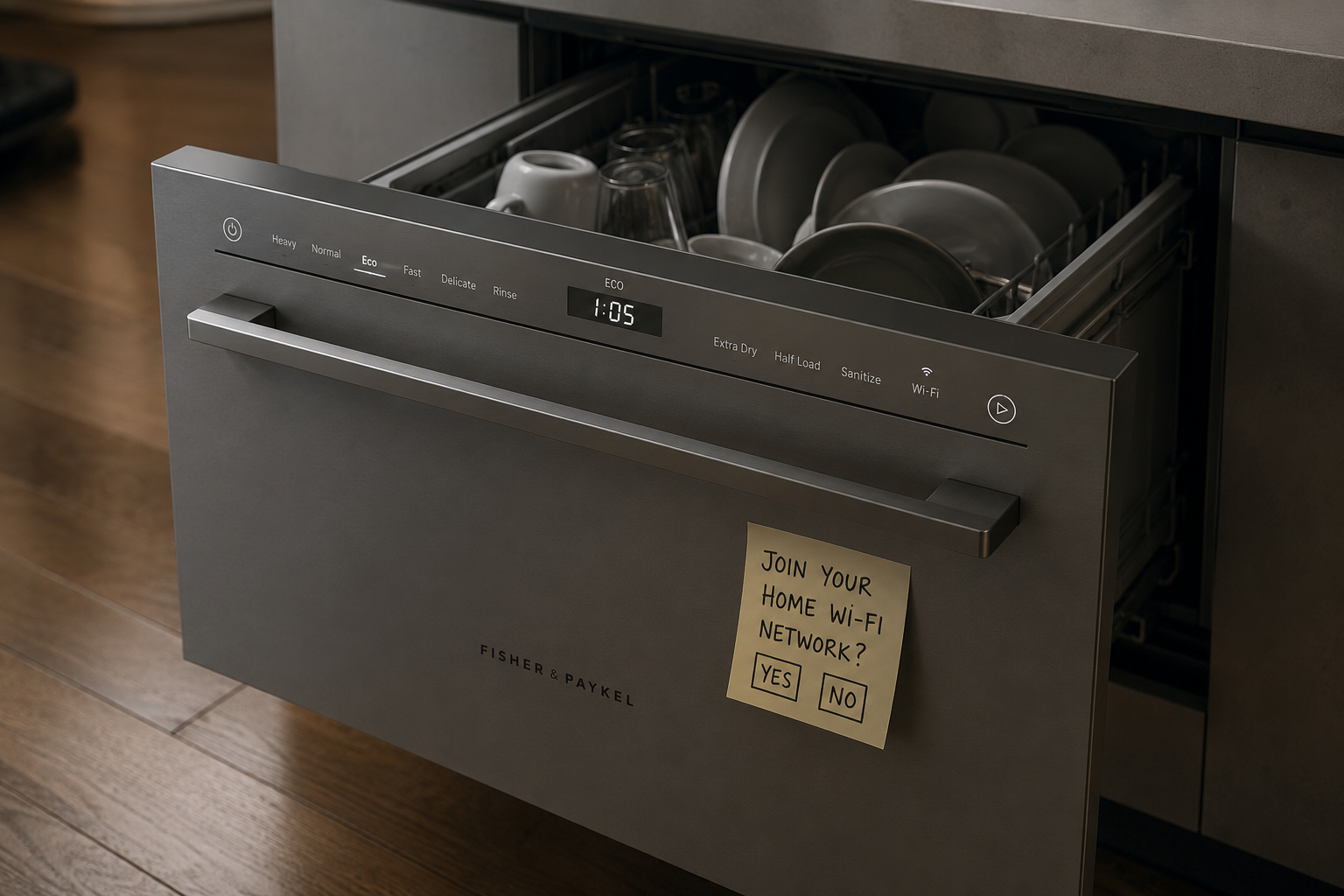
Our new Fisher & Paykel DishDrawer was initially so quiet that I genuinely could not tell whether it had started.
You would press the button and then stand there in silence wondering whether:
- the cycle had begun,
- the machine was thinking,
- or whether modern appliance design had finally become entirely conceptual.
This became an actual household discussion.
Not:
“does it clean well?”
But:
“is it currently operating at all?”
During installation it also requested access to our Wi-Fi network, which felt slightly ambitious for a dishwasher.
Several weeks later, the silence ended rather dramatically when the DishDrawer suddenly began sounding like a commercial irrigation system under emotional strain.
Not mechanical violence exactly.
More:
pressurised aquatic distress.
The sort of noise that makes you instinctively pause conversations mid-sentence.
Because modern appliances are no longer designed to be understood by the people who own them.
I immediately began conducting amateur domestic forensics. The sound appeared during the fill phase rather than the wash cycle itself.
Already this felt ridiculous.
I do not particularly want to become a part-time dishwasher acoustics analyst.
And yet increasingly, modern adulthood seems to involve exactly this sort of reluctant interpretive labour.
You interact with systems that are extraordinarily sophisticated, but largely sealed from view.
So you learn to infer meaning from indirect signals:
a sound,
a vibration,
a warning light.
Which, now that I think about it, describes rather a lot of contemporary life.
Eventually I persuaded Joy to book a technician.
The confirmation email contained this extraordinary line:
“Please note our manufacturer’s warranty does not cover use and care of your DishDrawer™ Dishwasher.”
What a fascinating phrase.
“Use and care.”
Not foreign objects, or internal blockages.
Just a sort of vague implication that I may have failed the dishwasher on some deeply emotional level.
This was followed by an appointment window of 7am–12pm, which is not an appointment so much as a period of administrative house arrest.
Modern dishwasher ownership also now requires navigating the increasingly confusing doctrine surrounding rinsing dishes.
For most of human history the instruction was simple: rinse your dishes before putting them in the dishwasher.
Then at some point appliance manufacturers collectively announced that, actually the machine prefers filth.
Not total filth obviously.
But apparently enough carefully calibrated residue to satisfy the sensors while simultaneously avoiding the introduction of accidental hazards.
Some time towards the end of the allotted appointment time, The Technician arrived.
The problem was a toothpick.
Not in the accessible filter.
In another filter hidden somewhere deep within the machine and inaccessible to the owner, but apparently perfectly positioned to create an acoustic experience remarkably similar to the final propellor checks on an Air NZ regional flight at the end of the day.
Anyway.
The machine is unsettlingly quiet again.