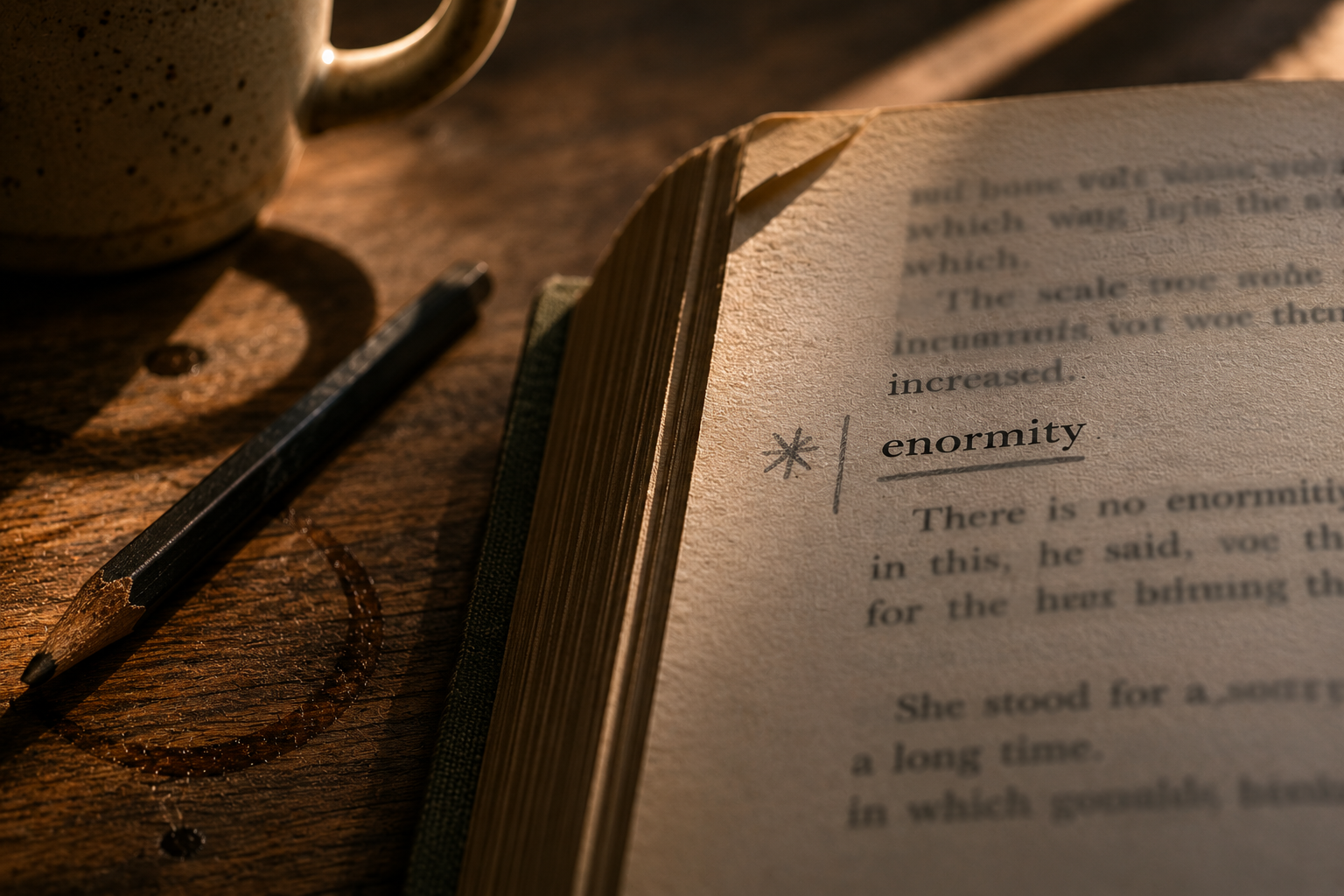
“Enormity” does not mean very large.
It means morally monstrous.
This is one of those wonderfully irritating semantic distinctions which makes pedantic people briefly insufferable at dinner parties before everyone else resumes enjoying themselves.
Most people now use “enormity” to mean:
- huge scale,
- vastness,
- or enormous size.
As in:
“the enormity of the building”
“the enormity of the task.”
And to be fair, this usage has become so widespread that dictionaries have increasingly surrendered to it.
Language evolves.
When people are allowed to be wrong collectively for long enough that eventually they become correct.
But the older meaning remains interesting precisely because it preserves a distinction modern English quietly struggles to maintain.
When you refer to “the enormity of the Holocaust you are saying something different — and more significant — than “the enormous scale of the Holocaust.”
One refers to size. The other refers to moral horror.
Flattening “enormity” into a synonym for bigness quietly erases that distinction.
Despite the gradual capitulation of dictionaries, the word still carries with it something beyond scale.
Not mere size, but moral gravity.
The word becomes less useful precisely at the moment people believe they are using it most impressively.
Which is perhaps the real tragedy of semantic drift.
English is full of words slowly dissolving into broader, softer, less precise approximations of themselves:
- “literally,”
- “decimated,”
- “nonplussed,”
- “disinterested.”
Each surrendering some tiny fragment of conceptual specificity in exchange for conversational convenience.
And honestly, this is probably unavoidable.
Human beings do not really treat language as a precision instrument. We treat it more like a collectively negotiated weather system.
Still.
Some distinctions feel worth preserving.
Anyway.
Please misuse responsibly.